Thursday, September 25, 2025

Kindness, Compassion, Giving Groups - Why are they dominated by women?


Lately, I’ve been noticing a pattern—one that repeats across teams, communities, and even leadership circles. When kindness is extended or compassion is offered, it’s often women who lead the way.

This isn’t to say men aren’t capable of deep empathy or care. Yet, in the spaces I inhabit – friends, neighbourhoods, corporate groups … it is women who consistently show up to soothe tensions, provide succour and relief, with immense generosity and grace. This ranges from running schools for underprivileged children, or raising awareness and compassion for dogs, or collection camps (from blood donation to clothing to food to waste management). Even our neighbourhood has groups dedicated to selfless giving, consisting >90% women.

I wonder why? Is it social conditioning? Is it invisible expectation?

I do not believe that men are not compassionate. I am privileged to know many kind, selfless, giving men. Yet they are not a part of the compassionate initiatives I am involved with or support.

Could this be because we are not creating an environment in these groups where men feel comfortable? Are we women consciously or unconsciously excluding them?

I’m sitting with these questions—not to assign blame or praise, but to surface a truth that I think deserves attention. Because when compassion becomes gendered, we risk undermining and overlooking its strategic power. And when kindness is expected but not valued, we risk burnout in those who offer it most.

What do you think?

Tuesday, September 9, 2025

Fracture - A Pebble and a Path


I walked hugged by morning sun and frangipani.

My favorite path, worn hard by purposeful feet
Turned a pebble to sly and silent traitor.

A twist, a fall
Right ankle, loyal, now betrayed,
A chip of bone in silence laid.

When I heal, I’ll walk once more,
Past bougainvillea blush and on pebbled floor.

I’ll remember how life can bend
And still
Somehow
Begin again.

Friday, April 23, 2021

I cry in the perfect storm of a pandemic

Today I cried,

When I read a tribute to a 53-year-old colleague who lost her life 2 days after her husband's,

When my cousin lamented being unable to meet his mum, not knowing when, and if, he ever would,

When my friend lost her dad a day after she reached out to me for help to find him oxygen, and caregivers,

When I saw a 65-year-old gingerly cradling an empty oxygen cylinder as she walked swiftly away from an ICU, her fear writ in her gait.

Today I cried.


That day I cried,

When I realised, India’s steep climb of cases would mean I would miss my niece's wedding,

When 1.3million people decided to dip themselves in the divine nectar of immortality while condemning 100s to a breathless lonely death,

When rallies garnered support from the people whose health, livelihood and life meant less than the paper on which they vote,

When the injustice to millions of children forced to learn online for 14 months is balanced by adults unwilling to campaign online for a fraction of the time,

When I saw the plight of millions of migrants walk 1000s of kilometres home, abandoned by those who should uphold their rights and welfare,

That day I cried.


I cry for

The daily wage earner who begs for money from our homes, to feed her children,

The household helper, who can't visit his dying mother, to hold her hand one last time,

The helplessness, despair, and tears of our healthcare workers who appeal for common sense and self-preservation.

​​I cry with them.


I cry out in anger,

At the reactionary emergency meetings

Held too late in the corridors of power,

When what we desperately need is swift proactive action.


In helplessness I cry,

As I realise, we are in a perfect storm of

A deadly virus,

A huge careless population, and

The deliberate negligence of governance.

Saturday, January 2, 2021

An Abundance of Joy - 2021

May she bring you an abundance of joy.
Joy in simple things.

The joy of a smile from the heart,
Or a fleeting fond memory.

Joy in a tingling tantalizing taste,
Or the waft of a familiar fragrance.

Joy in the whisper of a wish,
Or the familiar strains of a song.

Joy in an act of kindness
Or in the gift of gratitude you give yourself.

Here’s to a better 2021

Thursday, October 8, 2020

5 Life Lessons from My Journey with Adult Coloring Books

I want to be the fish in the mint cool river Free flowing escape on my mind
I started my coloring journey in late June 2020 during the Covid-19 pandemic. I had been gifted the book a couple of years ago. Once a while, the book silently crept into my thoughts and was easily ignored. When it knocked on my mind's door, I would calm it down by telling myself that colors needed to be bought.

I believed that I didn't have an artistic bone in my body. I can't sketch or paint or sculpt or play an instrument or sing. So how can I color? That too pages and pages of intricate drawings in Enchanted Forest. I would be really bad at it. I would fail.

I got my starter kit in June and till now I have done 23 pages of coloring. I am thoroughly enjoying myself. It is meditative and therapeutic at the same time

I have learned some valuable life lessons till this point in my journey.

LL1: Passion / interests are all around. Staring me in the face. I just have to take a risk and jump right in. 
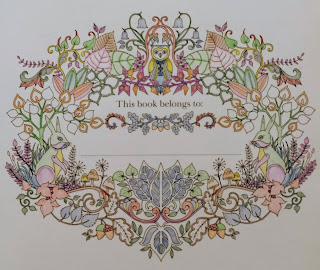
The title page. Name not written.
Perhaps waiting to learn calligraphy.
A passion or interest may be something you have never tried before. Or you think you might be bad at. I smashed the belief that I can't color in 2 steps.

Step 1 was to just buy a starter kit of colors. Not too expensive or too cheap, so that I would not feel bad if I had to give them away when I failed.

Step 2 was to start colouring. I started on the title page (and did not write my name on the page). Again, playing it safe, so that others could use the book if, I failed.

The voice in my head still said "I can't" & "I will fail". Till I started. And I saw that I wasn't as bad as I thought.

At work (as in personal life), don't let your mind prevent you for starting something you have never done before. Jump right in give it a go with an open mind. Start with small steps. Celebrate the wee successes. 

Emerald Ice and Orange Lollie castle
LL2: People's reactions matter. I need validation. I choose my "validators". I keep them close.

We all need validators. People who give us honest critical feedback, praise and encourage us, share thier knowledge, or just guide us to try different things. These people also provide us a safety net so that we can jump off a cliff, once a while.

I would not have continued to color and share my work, if my friends did not like, comment, give and seek advice on coloring. Some of them artists themselves. 

I also followed social media groups of people who openly share of themselves and thier art. To read and watch what they do, thier techniques, thier creativity. I am so grateful to them.

Building a network of people who don't hesitate to give critical feedback is essential to grow our careers. We also need people who advise, encourage, and cheer us on. Validators at work.

So many mistakes in this one
LL3: I will make mistakes. It's OK. The world will not end because of my mistakes.

To me, my coloring mistakes are glaring and stand out. I spot them immediately. Yet I still shared pictures with mistakes. Why? To get feedback. To seek some balance from the perspectives of others.

Often, others could not see what I thought were glaring mistakes (or they were too polite to tell me). So it wasn't as bad as I thought.

I do not know of a single project or initiative where mistakes and setbacks have not been an integral part. Professionally, I've learned to move on. Not to rethink, rehash, relive, and redo, ad nauseum. Rather, I spend time to understand why something went wrong so that I can prevent it from happening again. Or to learn how to recover from setbacks. 

I've learned that mistakes do not define who I am. Mistakes are a part of my journey.

This bountiful chest of treasures reminds me
that I need to focus on all that I have
and not what I have lost
LL4: The more I learn, the more I am able to learn. 

I am fortunate that my work requires me to learn something new everyday. The more I learn, the more, I think, I am programming my brain to learn.

For someone who thought I could not color - a skill that young children have and revel in - I learned about coloring in my 50s. About colors that compliment each other. About contours, highlights, hues and shades. About different types of coloring methods.

I realise that I can learn anything I want to, if I really want to. At my pace and time.  

So learn something new regularly. Get a mentor or coach or teacher if you need one. Or just learn by yourself. Explore. Experiment. Practice to become better. 

Any direction is the right direction if I am centered well
LL5: I can be individualistic and creative even when I have to work "between the lines"

I believe in processes, rules, regulations. They give me comfort. They make things consistent. They can also be restrictive and boring. And sometimes just wrong. Even then, I don't break rules or violate processes. I respect them enough to change them if they don't work for me.

Starting on a journey of coloring between the lines felt strange. Would I get frustrated and give up if I was forced to conform?

Conform, I didn't. Leaves were colors other than green. Animals were purple and red. I added lines, and curves, and dots. 

The workplace is also full of standards, rules, and processes that have to be followed. Yet you can question status quo, bring in creativity, find an innovative solution, change the way you and your team work. All with a goal to improve outcomes and experiences.

My coloring journey continues. I am sure there will be much to learn and change. 

If you are interested in trying your hand at coloring, I started with:

2. Starter kit of colors consisted of water soluble  color pencils and gel pens from HobbyCraft India


Wednesday, September 16, 2020

How to find the right mentor

Over the last 4 years, Diversity Dialogs has trained and coached over 3000 women in middle to senior management. We are often asked, "How do I find the right mentor", or worse still, "How can I get a mentor assigned to me?" 


I believe that the foundation of mentoring is performance. You have to have good performance. Not  outstanding / superlative performance. Good performance is good enough. High performers are often selected by mentors themselves. It is the rest, the good performers, who need to find mentors.


You have to have good performance that showcases your expertise, impact and values, if you want to find a mentor.


Assuming you are a good performer, here are the steps I recommend you follow to find the right mentor. The steps are broken into 3 phases:

  • Phase 1: Self-evaluation and Preparation 
  • Phase 2: Search and Select 
  • Phase 3: Take Action 
Phase 1 : Self-evaluation and Preparation 

Step 1: Be clear about your career aspirations. Write them down. State what you want to achieve in the immediate future, after 2 years and after 5 years. List roles and not statements that just float in ether, like, "I want to do something more challenging" or "I want to lead operations for a more complex customer".  If your aspiration is non-specific, then how can you expect to find a mentor who can help you get to where you want to go ('coz even you don't know where you are going).

A career aspiration is not a designation. It is a role.

You may need to craft a role, if none exists. Design it, garner support, sell it.

But role it must be, as it helps people slot your aspirations within the organization's framework and makes it easily recognisable and relatable.

Step 2: Determine the real gap between your current skills and skills needed for the next and future roles. Conduct a brutally real and honest evaluation. Refer to critical feedback. Request a special evaluation. Have candid conversations with people. 

Also, create a specific list of skills needed for the roles in your career aspirations path.

Underestimating or overestimating the gaps can lead you to waste time in acquiring skills you may not need. Worse still, you may look for and build a relationship with a mentor that does not help you grow your career. 

Don't forget to jot down and share the achievements that highlight your current skills / expertise. They come handy when you want to establish a baseline. 

Step 3: Create and execute a skill gap closure plan. You have to know which skill gaps you can close by learning, or taking on a new/expanded role or project etc. 

You have to take skill building actions to know where are you getting stuck and where you need help. Try solving roadblocks yourself first. When you can't - you've probably narrowed down the areas where you need mentoring. You can not be specific about the situations, your actions, what's worked and not worked. All needed to determine at what level you need mentoring.   

Don't identify more than 3 areas where you need mentoring. Anything more, de-focuses your conversations and efforts. 

Step 4: Flesh out the end objective / outcome of the mentoring relationship. Write a list of questions you would like to answer or outcomes you want to achieve by the end of your mentoring relationship. Get as specific as you can. 

This sets the boundaries of the expectations of the relationship. 

Don't expect your mentor to have a magic pill or wand or crystal ball that will dramatically reveal your needs to them. 

Having clear expectations, also helps you close a mentoring relationship gracefully if you are not getting what you want.

Mentoring is not an unending, forever relationship tho' at the end of it you may become friends. When that happens the the relationship moves into the realm of friendship. 

Friends can be (and often should be) mentors. Mentors do not have to be friends.

Phase 2: Search and Select

Now that you know where you need help, the specific areas, you can go out to find someone who you would like to be mentored by.

Step 5: Create a list of people you admire for the display and impact of the skills you are looking for. These have to be people in your network. People who you have helped. People who who have benefitted from your successes or capabilities. Only if you have given in some way can you expect to receive in return. 

Brain Lightbulb Blue - Icon , Transparent Cartoon, Free Cliparts &  Silhouettes - NetClipart Expecting to be mentored by someone who does not know you, is a pipe dream. It's not going to happen.   

If there is no one in your network who meets your criteria, then go out to cultivate them. Help them. Showcase what you are capable of. Yes, this will take time, but it's better than nothing. 

Some organizations assign mentors to people. I suggest you not rely on that. You have to Take Charge© of your career and find the right mentor for you. When someone in HR finds you a mentor, they will find someone they think will give you, what they think you need, & someone who they think (again!) will gel with you. Do you really want to rely on what someone else thinks about you or do you want to depend on knowing yourself well? 

Always have a Plan B (and possibly a Plan C). The first person you choose is not always going to be able to help you. So have list of the top 3 people you would like as mentors in each area. 

Mentors are not necessarily people who are senior to you in an organization. 

Depending on what you need to be mentored on, the mentor could be someone junior in age or experience. Look for people with superlative, demonstrated skills  in your area of need.

Step 6: Determine what you can offer them. A relationship is not worth it if there is no give and take. When you are selecting a mentor, be clear about what you can offer them. This means you need to understand them well, know what they are doing, challenges they face, tasks that they could or would like to be relieved off, etc. Research them well.

Be ready with more than one helping / giving option.

Weave this into the conversation vs asking your mentor if you can help them with something. 

Phase 3: Take Action     

Step 7: Ask for what you want. Not, "I would like you to mentor me" or "Will you be my mentor?" Throwing out a generic comment like that does pull anyone into a relationship. 

It's better to ask for specific help (remember you jotted some things down in Step 4?) Set expectations clearly. This also helps your mentor understand the time and effort they need to invest and what the exit conditions or criteria are.

For example, if you want to be mentored in public speaking you could tell them that you want to establish your expertise by speaking at a seminar. Then ask  what helped them become a called-upon speaker. How did they start? What strengths and connections did they use? What strengths or connections should you be leveraging? What pitfalls should you be careful of? Share what you have done in the area of public speaking. What's worked and what hasn't.


Step 8: Sign a contract.
If the help and support you need requires a series of conversations or meetings, create a contract. How often do you want to meet / chat, for how long, where, what time works for both of you, what's the best way to reach out to each other, the outcome of these sessions, etc.  

I have found that my most successful mentoring relationships have been those where we had set clear boundaries, expectations, schedules etc.

Though a contract has responsibilities of both parties, you need to drive it and not your mentor. You are the main beneficiary and you need to take ownership.

The contract does not have to be a written contract. Your word is as good as any signature. 


Step 9: Let them know if you have other mentors.
It is quite possible that you may have more than one mentor at a time. Its respectful to let your mentors know that there are others who you are seeking support and advice from. My suggestion is that you not have more than 3 mentors at a time as you may get confused. Also, you may like to work with them on different aspects or skill gaps you.

Step 10: Always do what you promise to do, when you promise to do it, and with the level of quality that your mentor expects. The most insulting thing you can do to a mentor is not to put into action what you have agreed to. And not to report back your progress, successes, and challenges. Mentors can only help if you let them experience how committed you are to growing and how far you have travelled.

Do more than is expected or agreed on. Mentors want to see initiative and your ability to extrapolate from your conversations

Your reputation as a protégé precedes you. If you get a reputation of being someone who can not or does not implement actions, it will tarnish your other relationships and make it harder to find a mentor in the future.

Here are additional tips on how to be a successful protégé